Thursday, 30 May 2013

St. Peter and Paul Primary to get a 3-unit classroom block


30-05-13      
A ground breaking event for the construction of a three unit classroom block for pupils of St. Peter and Paul Primary school has taken place at Atulba Daboo in the Upper East Region. The project which will be funded by the country’s biggest retailed outlet Melcom, will help improve the school’s infrastructural deficit which has been a major challenge bedeviling effective teaching and learning at the school. The Joint Managing Director of Melcom, Ramesh Sadhwani said his outfit as the largest chain retail outlet has  for years given priority attention to education in the country and has for this reason developed an action plans to see to the infrastructural needs of less endowed schools in the country.  In view of this the company intends to facilitate the construction of schools in remote and peripheral areas of the country as a way of given back to the community. The intended projects, he moreover, said will be pursued under a project dubbed Melcom Care Foundation. According to Mr Sadhwani told Radio Ghana that the ground breaking ceremony of the 3 unit classroom block symbolizes the beginning of the foundation which he indicated will be replicated in other areas of the country particularly remote communities of the Northern Ghana. The Headmistress of the school, Maragaret  Ayarik bemoaned the deplorable nature of structures at the school describing it as death trap. For her the successful construction of the project will go a long way to increase school enrolment and also ease congestion at the school. Madam Ayarik, was therefore grateful to Management of Melcom for the gesture, and promise to accommodate the project as their own in order to ensure its safety. She however urged other institutions to support the school with other educational facilities to enhance academic performance of pupils. Meanwhile, the Joint of Melcom in the company of other dignitaries including chiefs and other government officials facilitated the opening of a new Melcom branch for the people of Bolgatanga. Present at the function included the Bolgatanga Municipal Chief Executive, Edward Ayagle, and the Paramount Chief of Bolga Traditional Area, Naba Martin Abilba among other functionaries. The official opening of the new edifice stocked with variety of goods and services ranging from household wares and electrical gadgets witnessed an appreciable patronage by a section of the public who were there to grace the occasion. Addressing the gathering, the Director of Communications Melcom Group of Companies, Godwin Avernogbo, said Melcom has for years brought a whole new shopping experience to Ghanaians due to its adopted policy of low prices and high volumes for the general public. This, he noted, has undoubtedly contributed to bringing the cost of living down as people benefits from their reduced prices.  He therefore encouraged the public to continue shopping with Melcom in order to reap much benefit. Mr Avernogbo in his late submission urged staff of the new branch to prioritize customer care since it was key to enhancing the company’s financial obligations which will in turn open greater job opportunities for them.
GBC                                                        END                                                                        IA/

Friday, 17 May 2013

U/E RM orders the closure of all illegal mining Sites


17-05-2013                    
Following government’s resolve to flush out Ghanaians and foreign nationals engaged in illegal mining in the country, all mining sites in the Upper East Region particularly those with or without prospecting license from the Minerals Commission (MC) had been asked to close down with immediate effect. The Upper East Regional Minister, Alhaji Mohammed–Muniru, who gave the directive during a tour to some mining areas in the Bawku West and Nabdam District, warned that the influx of foreign nationals operating in illegal gold mining was against the laws of the country, therefore such group of individuals is considered as invaders and should not be entertained. Accompanied by some government officials and a combined police and immigration officers, Alhaji Muniru, instructed owners of all illegal mining sites to seek for the necessary permit and authorization from the offices of the various Municipal and District Assemblies as well as the MC  before operations can continue. Moreover, all Municipal and District Chief Executives (MDAs) and their respective District Security Committees (DISEC) have been tasked with the responsibility of ensuring that all small scale mining activities possess the requisite authorization since such activities pose a serious threat to the nation’s natural resources including water bodies, forest and farmlands. According to him, the two institutions would be held accountable for any illegal mining activity in their areas of jurisdiction. Alhaji Muniru told Radio Ghana that considering the dangers associated with the practice coupled with retaliation tendencies by Ghanaians and some Chinese nationals, it has become imperative for government to take drastic measures to keep the activity in check in order not to jeopardise the country’s peace. He was emphatic that any activity that was in contravention with the mining laws of the country was regarded as illegal, adding that persons that flout these laws were liable to arrest and prosecution. Alhaji Muniru therefore appealed to small scale mining operators to respect the mining laws and attach much importance to the safety aspect of those laws. Areas visited by the Regional Minister and his entourage include Zoog, Yakote, and Nangode all in the Nabdam District. In the Bawku West District, the team also toured a concession owned by the Widnaba Youth Association at Widnaba. At Zaronga which was the last point of call, Alhaji Muniru cautioned owners of the site not to recruit children to undertake any mining activity since it was against the laws of Ghana and warned that the government have the power to revoke licence acquired if found involving children in their operations and also subleasing their concession to foreign nationals. He was accompanied by the DCE, Alhaji Adam Moro, the Presiding Member, Mr Moses Aduk- Pam and the Regional Police Commander DCOP Isaac Alex Quainoo.
GBC                                                                              END                                                                             IA/

Wednesday, 15 May 2013

Women advocates wish for speedy passage of the Affirmative Action Bill


15-05-13 
RM Alhaji Mohammed Muniru

Ms Sophia Ackumey reading the communique

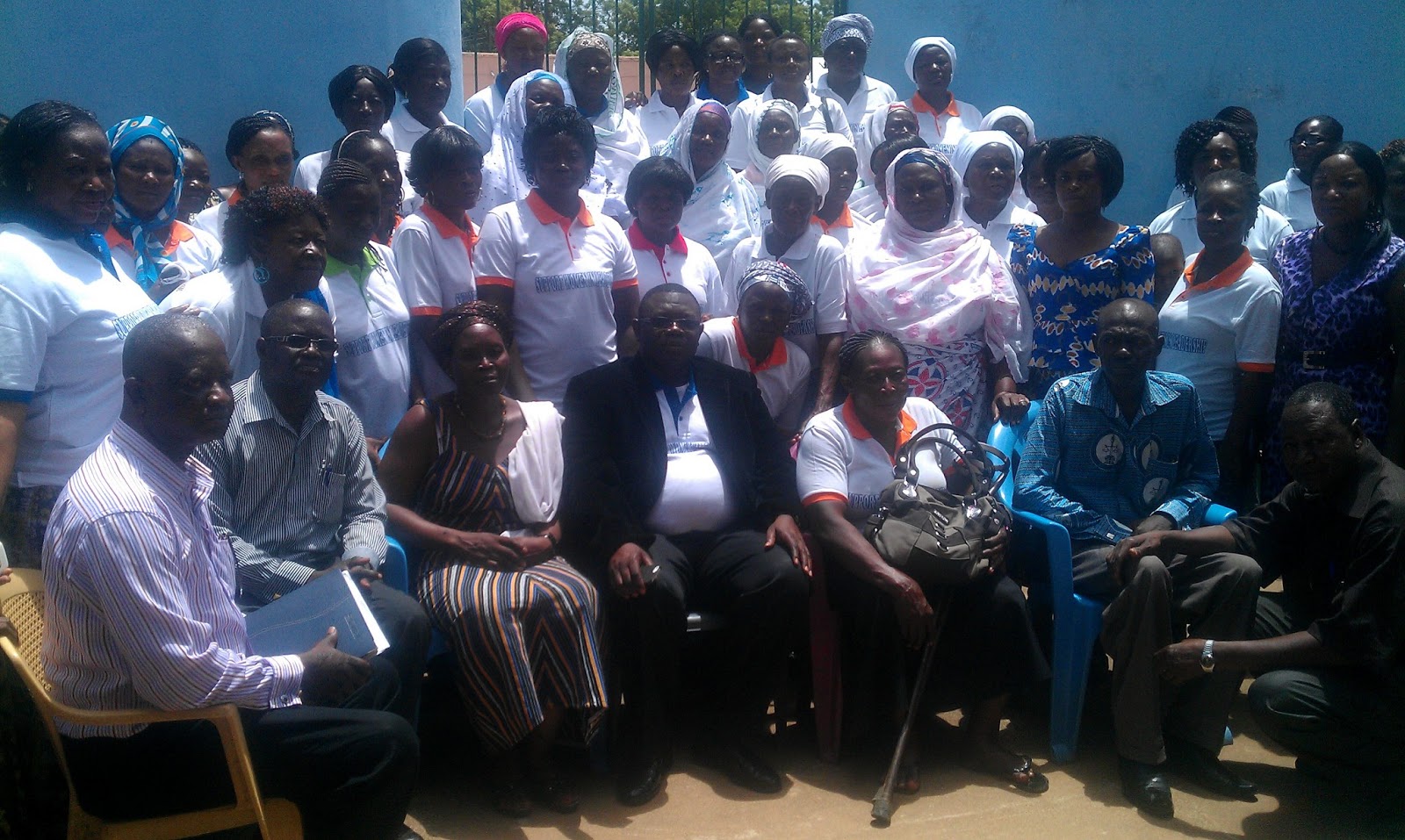
Group Photo wit RM

Women advocates in Bolgatanga, the Upper East Regional capital are challenging government to as soon as practicable speed up the passage of the Affirmative Action Bill into law. The passage of the said bill backed by its effective implementation will mean that women would be empowered enough to take their rightful position in society. More importantly, women will be given a fair representation in the governance of the country. At a day’s durbar to advocate for the passage of the bill, the women drawn from NGOs and Civil Society Organisations among other stakeholders emphasized the need for all to empower and alleviate the plight of women both financially and economically to enable them reach their desired goals and aspirations. They also challenged women who have positioned themselves in leadership and has become role models to reflect, identify and support the girl child to develop their potentials. They described as false the widespread notion that women are their own enemies, explaining that most women due to cultural and political dimensions are made to succumb to certain principles that refrain them from participating in decision making process of any kind. For her part, the President of the Past and Present Assembly Women’s Association (PPAWA), Agnes Atayila, entreated women to be confident in themselves since they have all it takes to compete with their men folks. She was optimistic that with the little support and determination women will be able to aspire for any leadership position they desire. The Manager of Action Aid Ghana, Kusi Boamah said the affirmative action is intended to promote the opportunities of defined groups within a society, therefore the passage of the bill, whose final draft was validated in koforidua last month, will make it mandatory for recruitment of women into key leadership and decision making positions in the country. He however asked government to prioritize the bill and fast track its process. The Chairman of the Regional Inter Sectoral Gender Network (RISEGNET) D.J Abang-Gos expressed grave concern about the low participation and representation of women in decision making in the region and urged women to rise up to the challenge. The Upper East Regional Minister, Alhaji Limuna Mohammed–Muniru, said in as much as we advocate for the speedy passage of the bill, there was the need to ensure that the girl child is inculcated with the values of positive attitude in her outlook of life and also be oriented to rise against barriers in attaining her goals as an individual. In his late submission, Alhaji Mohammmed Muniru, concluded that government was in the process of speeding up the passage of the bill, stressing that government has consulted key stakeholders including women groups and considered their inputs.  At the end of the durbar, Sophia Ackumey, a women advocate presented a communique to demand the speedy passage of the bill into law. It was received by the Minister for onward presentation to the President for consideration. The durbar organised by RISEGNET with support from Action Aid was on the theme: ‘Affirmative Action: A tool for Women Development.
GBC                                                                      END                                                                                    IA/

Friday, 22 March 2013

EC is always firm and fair with regards to the legal framework: Says Sulley Amadu


Mr Sulley Amadu (Middle)
The Deputy Commissioner, Finance and Administration at the Electoral Commission, Sulley Amadu has reacted strongly to allegations pointing to the fact that the Electoral Commission was not firm on decisions taken with regards to legal frameworks governing the country’s electoral system. He explained that the EC as custodians of the country’s electoral process do not dictate or use its own digression on critical issues bordering on election but rather arrive at decisions based on consensus after consultation with its relevant stakeholders. Mr Amadu who was reacting to concerns raised by participants at the opening of a 2-day Review Meeting organised by the EC at Bolgatanga, said challenges encountered during the 2012 elections have been noted by the EC, stating that checks and mechanisms would  be considered to forestall future occurrences. The meeting which was being supported by KAB Governance Consult and DFID-UK among other collaborators brought together stakeholders in the electoral process including political party representatives as well personnel from CHRAJ and the NCCE. It was on theme: ‘‘Enhancing the Credibility of Ghana’s 2012 Elections’’. Reflecting on the challenges of the 2012 election, Mr Amadu recounted that even though the EC anticipated a possible breakdown of the biometric verification kits, it was difficult to combine both the manual and the electronic system of voting, emphasising that almost all political parties before the election insisted that electorates go through the biometric voting system, hence the popular mantra ‘No Verification, No vote’ (NV NV). The decision, he explained, was based on a unanimous decision taken during the National Inter Party Advisory Committee Meeting (IPAC).  According to him, the EC could have decided to take a firm position on the issue but because the EC is a listening organisation that tries to build consensus, it gave room for its stakeholders to decide for the interest of the electorates. In view of this however, the EC  incorporated the situation in the declaration of the results form by creating a column C3, where presiding officers took data of the number of registered voters that could not go through the voting process because of the breakdown of the kits. He told Radio Ghana that the EC has always listened to its critical stakeholders particularly political parties and would not impose laws that would undermine the integrity of the institution. The Regional Director of the EC, Mr Bruce Ayisi, in his submission revealed that the breakdown of the BVDs affected the smooth process of the 2012 election, adding that rejected ballot and the high rejection of voters due to traumatised fingers also posed a major challenge. Mr Ayisi therefore appealed to relevant stakeholders and electorates to bear with the EC in rectifying those challenges. He commended the various security agencies and the media for contributing to the smooth conduct of the election in the region and called for their continuous cooperation in ensuring a more credible election come 2016. The Review Meeting sought to discuss issues pertaining to the election, identify challenges that were encountered as well as to solicit recommendations for improving upon subsequent elections. 
GBC                                                          END                                                             IA/


Thursday, 21 March 2013

Media urged to influence public perception on agricultural biotechnology


Mr Otunge of OFAB
A staunch biotechnology activist, Daniel Otunge has challenged media practitioners to serve as lead advocators in publicizing issues of biotechnology in a manner that will improve public perception towards the technology. He said considering the role of the media in shaping public opinion on issues of societal interest, the media through positive and unbiased reportage could influence a positive change in the way people think about the new scientific development. Mr Otunge who is the Africa Coordinator of Open Forum on Agricultural Biotechnology in Africa (OFAB) told Radio Ghana’s Isaac Asare  that majority of the people in sub Saharan Africa including Ghana have varied perception towards biotechnology because some section of the media have sent wrong signal condemning the impact of the biotechnology on food production. He said most people in view of the negative reportage on biotechnology have to a larger extent thwarted the efforts of OFAB quest to introducing biotechnology; its principles and potentials uses in Africa and Ghana as a whole. He said in order to wipe out this perceived agenda, there was the need for knowledge transfer and balanced information to the public on genetically modified foods, which, to many, is regarded as unsafe for human consumption. Mr Otunge however underscored the need for the mass media particularly, science journalist to play a central role in setting the right development agenda for the public and policy makers in the on-going debate on biotech. Strong institutional framework coupled with workable policy legislation, he indicated, were some interventions necessary to advancing the cause of biotechnology in Africa and again called on the media to be agents of change by working closely with scientists and policy makers to define an African agenda for biotechnology. Non-adherence, he noted, would mean that Africa and for that matter Ghana will lag behind in terms of improved food production and would forever be dependent on food aid from countries that have adopted such innovative agricultural technologies. He said Agriculture in Africa is still faced with numerous challenges including poor irrigational facilities, pest attacks on crops, severe draught as well as bad agricultural policies among others. These challenges, he recommended, could be mitigated if the media plays its expected role in promoting better agricultural policies and adoption of new technologies. Focussing on the Ghanaian media , Mr Otunge implore journalists to provide credible biotech dialogue in Ghana that will facilitate improved and timely decision making on biotechnology  now that the country is poised to begin confined field trials of various biotech crops including cowpea, rice and cotton among others. He identified the media as the preferred sources of information on biotech to policy makers, legislators and farmers and called on them to contribute to building an enabling environment for informed and timely decision –making and also help create a better biotech framework to facilitate adoption of the technology.

GBC                                                                        END                                                                                 IA/    


Diocesan Caritas fetes in mates of Gambaga Witches Camp


Fr Paul Kapochina


The Magazia of the Gambaga Wiches Camp
Members from the Navrongo-Bolgatanga Diocesan Caritas led by Fr Paul Kapochina, have made a symbolic food donation to the Gambaga witches camp at Gambaga in the Northern Region. The food items valued at the cost of GHc 3,700 included 39 bags of maize and assorted drinks. The over 80 in-mates at the camp,who are mainly widows drawn from various communities and districts across northern were fete with cooked foods as they sing and dance to express their joy and appreciation to the donors. In his presentation, Rev. Fr Kapochina said the society on annual basis embarks on such friendly visits to the camp as a way of bringing smile on the faces of the inmates, who according to him have been neglected by their communities, family and friends. This, he observed has increased their vulnerability since they are occasionally made to suffer the pill of abuse, intimidation, deprivation and harassment when suspected of practicing witchcraft.  Undoubtedly these alleged witches are on moral basis denied access to their civic rights.  Moreover, conditions in the camps they live are nothing to write home about because access to food, health facilities, portable water, and other basic amenities are limited. Socially, their rights are not respected even though most of them are living with their children and grandchildren. It is at this backdrop that the society has taken upon itself to attend to their plight by contributing to their survival. Fr. Kapochina said the Catholic Church has the poor and the vulnerable at heart and would continue to demonstrate and employ all charitable means to make them feel part of the society. He said in as much as every citizen has the right to live and enjoy the basic necessities of life, it was therefore imperative for all to protect, love and show compassion to the needy when the need arises. Fr Kapochina, who is the Diocesan Chaplain at the St Vincent De Paul Society of the Catholic Church called on individuals and other corporate institutions to inculcate the habit of giving back to society as endorsed by the word of God. He urged the inmates of the camp to remain steadfast and pray to God to intervene in their lives. The Magazia of camp on behalf of the in-mates thanked Fr Kapochina and the Catholic Church for their show of humanity and prayed for God’s blessing on the church. She however appealed to other bodies to come to their aid. Speaking to Radio Ghana, the Coordinator of Presbyterian Go-Home Project, Sampson Laal, said his outfit through an effective re-integration programme has succeeded in to resettling some of the in-mates to be with their families. Under the said project, the welfare of the in-mates in the area of health care is given the needed attention. The only problem he noted was financial constraint which he noted has to some extent affected their operations. Mr Laal appealed to concerned bodies to support in that regard. Meanwhile, Fr Kapochina and his team members paid a courtesy call on the Gambarana, Naba Wini Yahaya at his palace to announce their presence.

GBC                                  END                                                                                                IA/
Fr Kapochina with Gambarana at his palace


Myself and some of the alleged witches


Tuesday, 19 March 2013

Students Call for the Return of Striking Teachers


19-03-2013                
Third Year Student of BOGISS

As the teachers on-going strike action enters its second day today, students at the various second cycle institutions in the Upper East Region are appealing passionately to GNAT and NAGRAT to consider the plight of BECE and WASSCE candidates by returning to the classroom. According to some final year students at the Bolgatanga Girls Senior High School (BOGISS), the on-going strike action is likely to have a bad and irreversible effect on their exams and would therefore urge the leadership of the two teacher groups to rescind their decision whilst government and the Fair Wages and Salary Commission (FWSC) deliberate on the way forward to resolving their grievances. Some of the students Radio Ghana spoke to expressed shock and dismay about the action taken by the teachers, adding that should government renege to heed to their call, the performance of candidates writing this year’s BECE and WASSCE would be disappointing because not all syllabuses have been covered and students would have tough time learning on their own. A final year student of BOGISS, Agyaa Veronica said she would be more than happy if government and the Fair Wages Commission intervene to attend to the striking teachers. She advised her fellow colleagues to sit up and learn as they wait for the authorities concern to address the grievances of the striking teachers. A visit to the Bolgatanga Technical Institute saw students loitering on campus with no teacher attending to them. Some of the teachers were also cited sitting under trees busily conversing with their colleague staff. A staff who spoke to Radio Ghana on condition of anonymity lamented on the plight of teachers, saying their concerns had been ignored for far too long and that government has taken them for granted. He described the on-going strike action as unfortunate adding that his major problem has to do with students who are due to write the technical as well as the General Business Certificate Exams (GBC). Such students, he stated stand the possible risk of performing poorly since psychologically; they are not prepared to write the impending exam. Additionally students would be made to write their end of term exam next academic term if government and the teachers fail to arrive at a workable solution. He expressed the hope that government would respond to the strike action with all the seriousness it deserves so that teachers return to their various classrooms to teach, invigilate and supervise the two student groups. The situation at the primary and junior high schools visited were not different as teachers abandon their classrooms with most spotted walking along the streets heading to their respective homes.  Pupils at Bolgatanga Preparatory Model School that spoke to Radio Ghana added their voice to the call for teachers to re-consider the plight of students by returning to the classroom. But notwithstanding their plea, the Deputy Upper East Regional Secretary for GNAT, Mr. Iddi Dokurugu says the on-going strike action is justifiable adding that government should be solely blamed for the unfortunate turn of event, which he reiterated, was intended to press home their demand for better service conditions. 
GBC                                                   END                                                           IA/